
By Dr. Stephen Timme, Founder & President, FinListics Solutions
Why industry financial drivers matter to enterprise sellers
Today’s CFO has evolved far beyond being the organization’s financial steward. CFOs are expected to improve financial performance, manage enterprise risk, and help drive business strategy. As a result, their priorities vary significantly by industry.
Many enterprise sellers believe they are selling value when they present cash flow benefits and ROI. While financial justification is important, it is rarely enough to engage a Chief Financial Officer in a strategic business conversation. CFOs want to also know how the investment align with their financial priorities. Presenting an investment with a great ROI but no alignment ends in a very short meeting.
The challenge for many sellers is that they assume financial priorities are the same across industries. In reality, they are very different.
Examples of industry-specific priorities
A retail CFO may be focused on improving inventory productivity and reducing markdowns. A life sciences CFO may prioritize accelerating clinical development to maximize revenue before patent expiration. A telecommunications CFO priority may be to maximize return on network infrastructure investments by increasing utilization of fiber, wireless, and 5G assets. Each executive is trying to improve financial performance, but the financial drivers that matter most are unique to their industry.
Enterprise sellers who understand these industry-specific financial drivers gain a significant advantage. Instead of discussing technology investments in isolation, they can connect their solutions directly to the financial priorities that influence investment decisions.
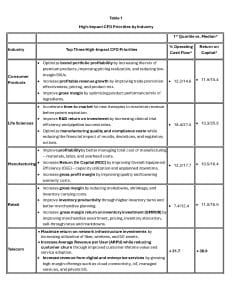
Table 1 provides examples of the highest-impact financial priorities for several major industries. Notice that while every CFO is responsible for improving financial performance, the priorities that create the greatest shareholder value differ considerably across industries.
Which priorities do your solutions help to enable?
Knowing a CFO’s financial priorities is only valuable if you can connect them to your solution.
For example, suppose you provide an AI-enabled supply chain planning platform.
You are engaging a retail CFO. Instead of saying:
“Our platform uses AI to improve inventory planning and supply chain performance which increases cash flow…”
You could say:
“My understanding is you are focused on improving inventory productivity while reducing markdowns and stockouts. Our platform improves demand forecasting and replenishment accuracy, helping retailers reduce excess inventory, improve inventory turns, and increase gross margin. For a retailer your size, improving inventory turns by only one day could free millions of dollars in working capital while reducing markdown expense and increasing operating profit.”
Notice the difference.
The first statement describes technology.
The second describes measurable financial outcomes tied directly to one of the CFO’s highest strategic priorities.
Technology is rarely approved because it is innovative. It is approved because it creates measurable financial value.
Better performers vs. average
All CFO focus on cash flow. Table 1 shows that better-performing (1st Quartile) companies consistently achieve higher operating cash flow as a percentage of revenue than the industry median — over 40%.
Return on Capital (ROC) is also focused on by CFOs and investors since it provides insights into overall performance. Table 1 shows that better performers deliver almost a 70% higher return than the average.
While no two companies provide the exact same products and service, which explains some cash flow and return differences, experience shows that these differences typically represent opportunities for financial improvement.
Financial value framework
This is a framework you can use to more effectively align your solution and engage with a CFO.
Solution → Financial KPI → CFO Priority → Operational KPI
For example:
- Consumer product: Price Optimization →Revenue Growth → Increase Trade Promotion Effectiveness → Pricing & Product Mix
- Manufacturing: Digital Twin → ROC → Overall Equipment Efficiency (OEE) → Materials, Labor, & Overhead
- Retail: AI Demand Forecasting → ROC → Gross Margin Return On Inventory Investment (GMOII) → Sell-Through Rate & Markdowns
Dr. Stephen G. Timme is President and Founder of FinListics Solutions, a company that helps B2B professionals develop greater customer insights and better demonstrate the value of their solutions. Before founding FinListics, Stephen was a professor of finance at Emory University and Georgia State University, an adjunct professor at the Georgia Institute of Technology, and a consultant for numerous Fortune 500 companies.