Insights from SAMA’s 2025 Pan-European Conference
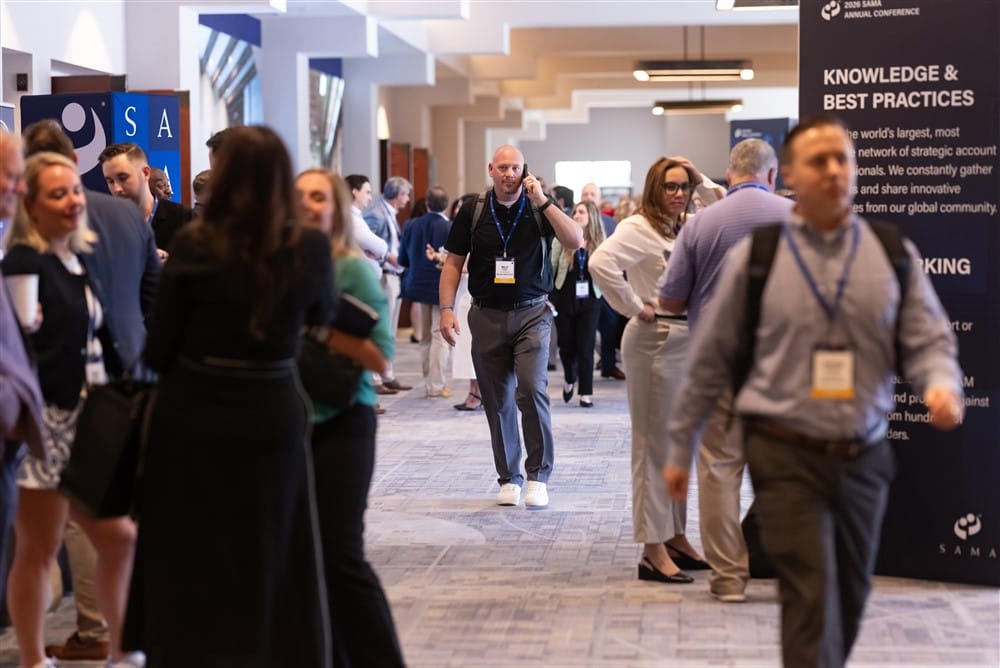
SAMA’s 2025 Pan-European Conference gathered global partners, practitioners, and thought leaders in Paris to explore how strategic account management (SAM) continues to evolve. Across sessions and keynotes, a clear, unified message emerged: SAM is not just adapting to change — it’s redefining how organizations grow, collaborate, and create value in an age of complexity, transformation, and technological innovation.
Below are some major themes and takeaways from the sessions that defined this year’s conference and set the tone for the year ahead.
The Enduring Value of the Account Manager in an AI Era
In her keynote, Namita Powers (Principal, ZS Associates) tackled a critical question: What’s the true value of the account manager when digital platforms, data, and AI dominate the commercial landscape? Her team’s multi-year research found that while digital tools enhance efficiency, trust remains the ultimate differentiator.
Today, the best account managers:
- Focus on partnerships, not products. They prioritize outcomes over internal agendas.
- Listen deeply to understand nuances in customer ecosystems and connect the dots on their behalf.
- Guide customers through complexity, which helps them navigate internal barriers to change.
- Support their people, not just their profits, to embed themselves in customer organizations as trusted allies and advisors.
Powers reframed the account manager’s role from “messenger” to “mainstay” — the stabilizing force that customers rely on for clarity, empathy, and judgement in a world inundated with noise and information overload.
Her “mainstay skills” — credibility, reliability, intimacy, and low self-orientation — offer a modern blueprint for cultivating trust at scale.
Leading High-Performing Account Teams
Joshua Dey (The Summit Group) addressed another cornerstone in strategic account management: leadership. His session, Leading High-Performing Account Teams, presented a fresh model for driving performance through collaboration instead of control.
Dey introduced the concept of the “Collaborative Quotient” — a diagnostic and coaching framework for assessing and inspiring a team’s collective effectiveness. Built around seven core dimensions — the 7D’s: Diagnosis, Discipline, Direction, Diverse, Divergent, Dialogue, and Do — this approach helps account leaders identify both the technical and human levels of performance.
He contrasted traditional VUCA (volatile, uncertain, complex, ambiguous) environments with the emerging BANI (brittle, anxious, non-linear, incomprehensible) reality. In this context, empathy, transparency, and psychological safety are not soft skills, they are imperatives for successful leadership.
Dey’s framework enables SAM leaders to manage both external instability and internal fragility, which can unlock team creativity, trust, and co-creation.
The Persuasive Power of Story: Guiding Clients to “Yes”
In a marketplace where, on average, buying journeys involve more than 11 decision-makers, the ability to craft and tell persuasive stories has never been more crucial.
Drawing on behavioral data and Gartner research, Catherine Alexander’s (Corporate Visions Inc.) keynote illustrated the “the buyer’s purchase jungle” — chaotic decision path where information overload and misalignment often end deals in “no decision.”
Alexander reframed persuasion as guidance built on three pillars:
- Acknowledge your incumbent advantage to leverage existing relationships and demonstrate results.
- Tell a customer-centric story to position the customer, not your solution, as the hero.
- Talk in terms of solutions and outcomes to quantify value in ways that resonate across stakeholder groups.
Breathing New Life into an Existing SAM Program
One of the most resonant discussions came from a GE Healthcare team that have been practicing SAM for years and are now asking: How do we keep SAM alive, relevant, and value driven?
This session by Andrew Middleton, Nigel Standing, and Imran Farid shared strategies for reinvigorating mature SAM programs by focusing on co-creation, customer voice integration, and executive alignment.
The big takeaway was that long-standing programs risk stagnation when they prioritize process over purpose. The best renewals involve:
- Re-segmenting accounts based on growth potential, no legacy status.
- Re-aligning KPIs to emphasize mutual value creation.
- Refreshing talent and rewarding behaviors that foster innovation and collaboration.
This session reinforced that SAM vitality comes from continuous learning and adaptability, not from adhering to established templates.
Driving Profitable Growth: Lessons from Saint-Gobain
In describing the evolution of Saint-Gobain’s key account management (KAM) program, one practical takeaway that emerged from their session was how strategic customer management became a catalyst for bother revenue and expansion.
Key initiatives included:
- Embedding SAM disciplines into pricing and contracting.
- Strengthening internal collaboration across business units.
- Using data analytics to quantify and communicate value delivered to customers.
Saint-Gobain’s journey illustrated that profitable growth and customer intimacy are not opposing forces. Instead, when KAM is engrained throughout an organization, they reinforce each other.
Empowering SAM Through Contracts, Pricing, and Ecosystem Collaboration
Jacques Orbach’s (Endress+Hauser) session explored how contracts and commercial models can either constrain or unleash value creation. He asserted that SAMs must evolve from negotiators to ecosystem architects by leveraging pricing structures, joint innovation agreements, and multi-party collaborations to align incentives and reduce friction across value chains.
This perspective pushes SAM into the realm of business design, where contracts are not just instruments of compliance, but strategic enablers of trust and innovation.
Influence Reborn: Rethinking Power, Trust, and Growth in B2B Relationships
This provocative bonus session challenged attendees to redefine influence in the context of modern B2B ecosystems.
Rather than relying on positional authority or transactional persuasion, SAM leaders were urged to cultivate relational power, built on credibility, empathy, and shared purpose.
This session emphasized that trust in the new currency of influence. In complex, multi-stakeholder buying environments, the ability to create psychological safety and mutual commitment determines which partnerships scale and which ones falter.
A Case Study in SAM Transformation: Wajax’s Journey of Disruption
André Dubé (Wajax) demonstrated how SAM can drive enterprise-wide transformation — a fascinating success story he chronicled on the featured podcast Disrupting Legacy Models: Wajax’s Transformative SAM Journey and companion Velocity article.
Confronted with internal fragmentation and customer frustration, Wajax launched their One Wajax program in 2016. It was a sweeping transformation aimed at eliminating silos, streamlining the business, and unifying its customer-facing approach. The organization also launched a strategic account management (SAM) program which became a key initiative of that evolution.
“Strategic account management isn’t a tweak,” Dubé said. “It truly is a transformation — one that requires the courage to disrupt legacy business models, one that requires structural alignment, talent investment, and relentless focus on co-creating new ways of developing value with customers and partners”
The Human Element in the Digital Age
One insight echoed across nearly all sessions: although technology amplifies and enhances, it does not replace the human side of SAM. From AI-enabled planning tools to digital contracting platforms, automation is freeing SAMs to focus on what truly differentiates them — empathy, creativity, and co-creation.
In fact, the meta-lesson of the whole conference stood out: strategic account management remains the most human discipline in an otherwise digital enterprise.
Conclusion: SAM as the Organizational Mainstay
SAMA’s 2025 Pan-European Conference reaffirmed the enduring belief that SAM is both an art and a scientific system.
As organization confront brittleness, anxiety, and turbulence, SAMs will be the ones steering their companies through complexity. To sum it up, the future of SAM belongs to those who can blend technology with trust, process with partnership, and data with empathy. SAMA’s 2025 Pan-European Conference didn’t just showcase new tools an ideas, it reminded the global SAM community of its unshakable purpose: to lead with courage, collaborate with intent, and co-create value that endures.